°The Blueprint
< BACK
GLOBAL
The Executive Blueprint for Sustainable Business Evolution
Most digital transformation efforts fail because organizations try to do too much, too fast. Instead of attempting dramatic overhauls, successful companies take a page from the automotive industry's playbook—they evolve systematically over time. Just as cars didn't leap from horseless carriages to self-driving vehicles overnight, businesses need to build new capabilities step by step while keeping their core operations running smoothly. The key is breaking big visions into smaller, manageable projects that deliver real value and build confidence along the way.
What separates winners from losers isn't just having the right technology—it's having the right support system. Beyond traditional project management, successful transformations need dedicated mentors who keep everyone aligned, maintain momentum when things get tough, and ensure the customer voice stays front and center. Organizations that master this evolutionary approach to change, treating transformation as an ongoing capability rather than a one-time event, position themselves to thrive in a world where adaptation is the ultimate competitive advantage.
Table of Contents
The Transformation Imperative: Beyond a Digital Facade
The Evolution Paradigm: Learning from Automotive Transformation
Strategic Architecture: From Vision to Measurable Progress
Execution Excellence: Micro-Projects and Momentum Management
The Critical Role of Project Mentorship: Beyond Traditional PMO Functions
Integration and Financial Strategy
Looking Forward: The Transformation Leadership Model
Contents
Introduction
Digital disruption reshapes entire industries overnight. The distinction between organizations that thrive and those that merely survive lies not in their ability to implement technology, but in their mastery of strategic transformation. The conventional approach to change management, characterized by grand visions and sweeping overhauls, has proven catastrophically inadequate. Success demands a methodical, evolutionary approach that mirrors the automotive industry's century-long journey from horseless carriages to autonomous vehicles. This approach is purposeful, incremental, and relentlessly focused on measurable progress.
Contemporary transformation failures share a common pathology. Visionary ambition becomes divorced from strategic execution. Organizations routinely attempt to leap from current state to fully realized digital ecosystems without acknowledging that sustainable transformation requires careful integration of existing infrastructure with emerging capabilities. The result is a landscape littered with abandoned initiatives, burned budgets, and organizational scepticism that poisons future change efforts.
The Transformation Imperative: Beyond a Digital Facade
Modern enterprises confront transformation challenges that extend far beyond technology deployment. True transformation encompasses operational model restructuring, customer experience reimagination, and value creation mechanisms that demand fundamental organizational evolution rather than technological overlay.
The emergence of Chief Transformation Officer (CTO, CDTO, CTIO) roles across industries represents recognition that sustainable change requires specialized leadership capable of bridging strategic vision with operational reality. Unlike traditional IT leadership focused on infrastructure and efficiency, transformation executives must orchestrate change across all business functions while preserving core competencies that define organizational identity.
Contemporary stakeholders expect seamless integrated experiences where multiple touchpoints create cohesive value narratives. This integration demands more than connecting systems. It requires reimagining how organizations create, communicate, and deliver value through real-time responsiveness, personalized experiences, and operational visibility that supports informed decision-making.
The Evolution Paradigm: Learning from Automotive Transformation
The automotive industry's century-long evolution provides the definitive framework for understanding sustainable transformation. Early automobiles lacked basic features considered essential today. They had no brakes, headlights, or even roofs. Yet each generation built systematically upon previous innovations, creating increasingly sophisticated vehicles without abandoning core transportation functionality.

This evolutionary approach contrasts sharply with contemporary transformation attempts that seek immediate comprehensive change. Modern automotive companies didn't attempt to build ultra-safe, environment protective, electronically operated vehicles in 1920. They developed progressively more capable vehicles that incorporated new technologies as they matured, and market demand justified investment.
Key principles from automotive evolution
Systematic building upon previous innovations
Incremental capability enhancement without abandoning core functions
Technology integration aligned with market readiness
Progressive sophistication through multiple development cycles
Current technological capabilities enable transformation timelines measured in months rather than decades, but the fundamental principle remains unchanged: sustainable transformation requires systematic evolution rather than revolutionary disruption.
Strategic Architecture: From Vision to Measurable Progress
The most critical distinction between successful and failed transformation initiatives lies in translating visionary concepts into executable strategies and tactical plans. Most transformation initiatives fail because organizations attempt to build complete visions from zero to 100% completion without acknowledging that businesses undergo constant changes and adaptations.

The Fatal Flaw of Vision-First Transformation
The vision-to-completion fallacy assumes static environments and perfect foresight. These conditions never exist in dynamic business contexts. Organizations that pursue comprehensive transformation as singular projects inevitably encounter several problems.
Scope creep beyond original parameters
Resource exhaustion from overextended commitments
Stakeholder fatigue undermining organizational support
Market shifts invalidating original assumptions
The Three-Pillar Framework
Effective transformation strategy requires three integrated components:
General Vision defines desired future state and value creation objectives without prescribing specific implementation approaches. Successful visions describe specific capabilities, stakeholder experiences, and operational outcomes that justify transformation investment while inspiring organizational commitment.
A Smart Strategy identifies priority capabilities, resource requirements, and development sequence based on several factors.
Impact potential and organizational readiness
Interdependencies between initiatives
Resource allocation balancing ongoing operations with transformation funding
Strategic prioritization ensuring foundational capabilities develop first
A Flexible Execution Plan breaks strategy into manageable projects with clear success metrics and adaptation mechanisms. Execution planning establishes frameworks for decision-making, resource allocation, and progress measurement that adapt to changing conditions while maintaining strategic direction.
Execution Excellence: Micro-Projects and Momentum Management
Transformation execution succeeds through systematic accumulation of small victories rather than singular dramatic achievements. The micro-project methodology breaks comprehensive transformation into manageable components that deliver tangible value while building organizational confidence and capability.
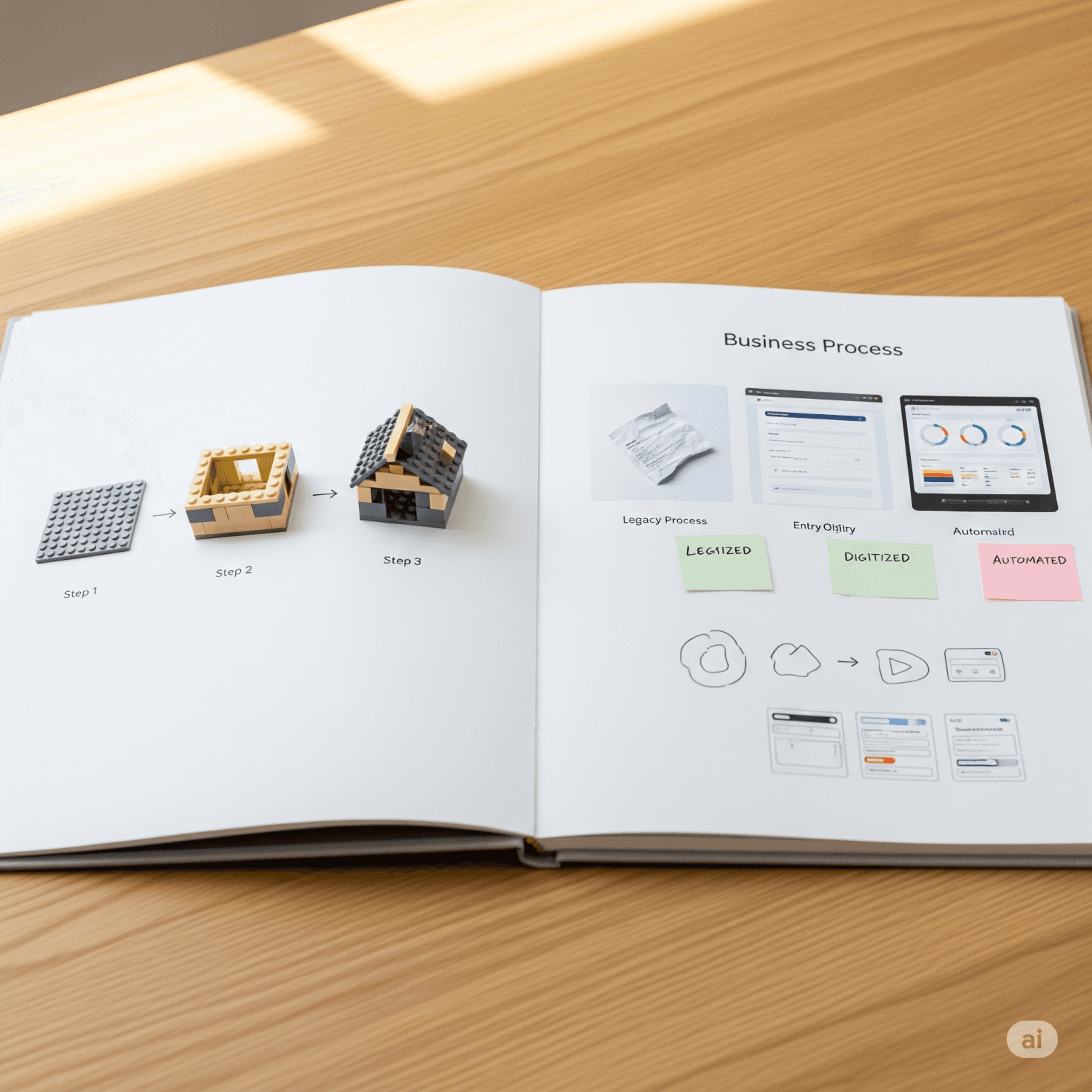
Each micro-project should accomplish multiple objectives
Demonstrate concrete progress toward strategic goals
Build internal expertise and confidence
Validate assumptions about market response or operational impact
Establish foundation capabilities for subsequent initiatives
The Measurable Progress Imperative
Measurable goals provide accountability and learning opportunities essential for strategic adaptation. Metrics must balance leading indicators that predict future success with lagging indicators that confirm value delivery. Project sequencing requires targeting high-impact, low-complexity opportunities first to build confidence and demonstrate transformation value.
The micro-project approach acknowledges that today's technologies enable transformation timelines measured in months rather than years. However, speed advantages only accrue when transformation proceeds step-by-step through carefully sequenced initiatives that build upon previous achievements.
The Critical Role of Project Mentorship: Beyond Traditional PMO Functions
The most overlooked component of successful transformation is dedicated project mentorship that operates alongside traditional Project Management Office (PMO) functions. While PMO focuses on process compliance, resource allocation, and schedule adherence, project mentorship addresses the human dynamics that ultimately determine transformation success or failure.

Project mentors serve as transformation guardians with several key responsibilities
Stakeholder Alignment Identify alignment opportunities and facilitate compromise solutions while maintaining focus on shared objectives rather than individual department interests
Customer Engagement Ensure customer voice remains central to decision-making while facilitating feedback integration that improves solution relevance and adoption
Momentum Preservation Anticipate momentum challenges and implement communication, recognition, and engagement strategies that sustain commitment through difficult periods
Change Psychology Recognize early warning signs of change fatigue and implement interventions that restore enthusiasm and organizational commitment
Transformation creates uncertainty, increased workload, and performance pressure that can undermine morale and productivity. Skilled mentors develop stakeholder-specific communication and engagement strategies that maintain support across diverse constituencies while addressing individual concerns during transition periods.
Integration and Financial Strategy
The Integration Challenge
Successful transformation requires seamless integration across technological capabilities, organizational structures, and operational processes. Technology deployment without corresponding process adaptation and organizational development inevitably produces disappointing results despite significant investment.
Critical integration areas include
People Integration New skills, modified responsibilities, and different performance metrics affecting every organizational level
Process Reengineering Eliminating unnecessary complexity while enhancing value-creating activities enabled by new technological capabilities
Cultural Adaptation Organizational cultures that embrace experimentation, learning from failure, and continuous adaptation through consistent leadership behavior
Financial Strategy: Investment Sequencing and ROI Optimization
Transformation investment strategies must balance ambitious vision with financial reality. Investment sequencing should prioritize initiatives that generate early returns to fund subsequent development phases in several areas.
Early Returns Operational efficiency improvements, customer experience enhancements, and cost reduction initiatives often provide faster returns than infrastructure development
Portfolio Economics Shared service development, common technology platforms, and centralized expertise create cost advantages while accelerating implementation
Risk Management: Maintain flexibility to accelerate or decelerate transformation pace based on market conditions and internal performance metrics
Measuring Success and Adaptation
Transformation success measurement requires sophisticated approaches across multiple dimensions
Leading Indicators Stakeholder engagement levels, capability development progress, and process improvement metrics
Lagging Indicators Financial performance, market position, and operational efficiency measures
Adaptation Triggers Performance variations, market condition changes, or technology evolution affecting transformation assumptions
Response Mechanisms Rapid adjustment capabilities that capitalize on opportunities and mitigate risks while maintaining strategic direction
Regular measurement cycles enable course corrections while maintaining strategic focus and stakeholder confidence. Balanced measurement approaches prevent overemphasis on short-term metrics that might undermine long-term transformation objectives.
Looking Forward: The Transformation Leadership Model
The future belongs to organizations that master systematic transformation as a core organizational capability rather than periodic disruption management. This requires leadership models that integrate vision, strategy, and execution while maintaining adaptability to changing conditions.

Chief Transformation Information Officers must combine several essential capabilities
Technology expertise with deep business knowledge
Strategic thinking with change management skills
Analytical rigor with emotional intelligence
Long-term perspective with short-term execution excellence
The organizations that thrive will be those that embrace transformation as continuous evolution rather than periodic reinvention through several key approaches
Compelling visions that inspire without constraining
Realistic strategies balancing ambition with capability
Measurable micro-projects that build momentum
Dedicated mentorship maintaining stakeholder engagement
The automotive industry's journey from horseless carriages to autonomous vehicles demonstrates that revolutionary capabilities emerge through evolutionary development processes. In a world where change is the only constant, the capacity for systematic transformation becomes the ultimate competitive advantage.
The path forward requires specific actions. Define compelling visions, develop realistic strategies, execute through measurable micro-projects, and maintain progress through dedicated mentorship and stakeholder engagement. The future belongs not to organizations that achieve perfect transformation, but to those that master the art of continuous, purposeful evolution.
KEY POINTS
DISRUPTION
reshapes industries
EVOLUTION
builds on previous progress
STRATEGY
is critical
EXCELLENCE
via micro projects